Luxury Pool Cage Enclosures Video
A 25-second illustrative video from West Coast Screening and Seamless Gutters LLC showing aerial and interior views of luxury screened pool and spa enclosures, ending with the company logo and phone number.
Visual description
This is a description of what appears on screen, not a transcript of spoken narration.
- Aerial views of a screened pool and spa enclosure beside a tile-roof home.
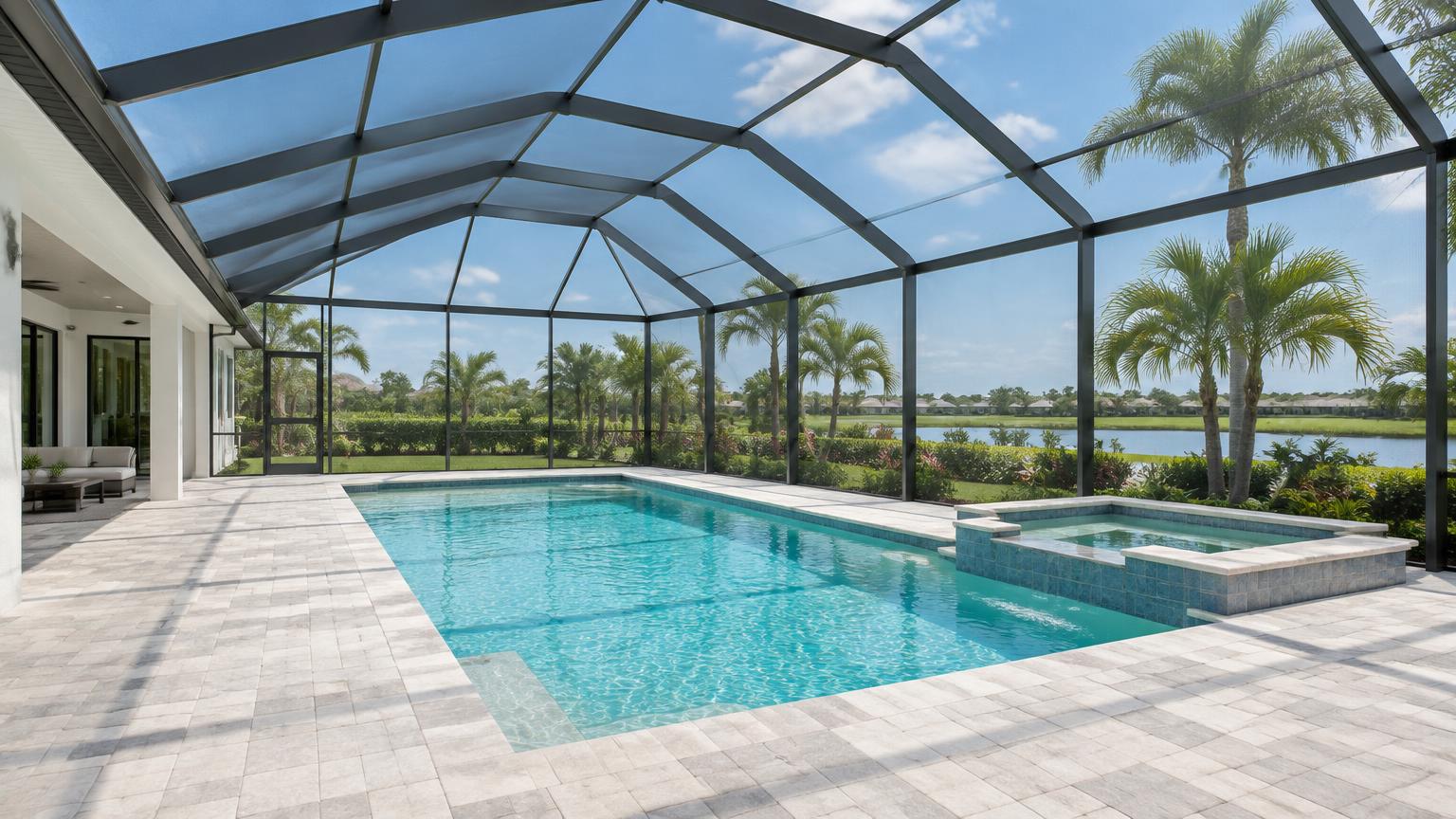
- Interior view through the enclosure framing across the pool at sunset.
- A closing frame with the West Coast Screening logo, phone number 941-999-8486 and website address.
Pool cage enclosures turn an open pool deck into a protected outdoor room. This video gives a short, illustrative look at the style of screened pool and spa enclosure many Southwest Florida homeowners picture when they plan a new cage or upgrade an older one. The guide below explains what you are seeing, what decisions shape a high-end enclosure, and how to prepare before you request an estimate.
Pool cage enclosures: what this video shows
The aerial shots show how a screened enclosure wraps a pool and spa beside a tile-roof home, tying into the house and forming one continuous outdoor living area. The interior shot looks through the framing across the water at sunset, which is how you will experience the space every day: the frame lines, the screen and the view beyond.
Because this is an illustrative video rather than a documented customer project, use it as a style reference. Your own enclosure is designed around your home, your deck, local code and the engineering for your site. For real completed work, see our Why Us page and the construction video.
Pool cage roof styles and how they change the look
The roof shape is the biggest visual choice in any enclosure. A mansard roof slopes down on the sides and is common on large residential cages. A gable roof creates a peaked, house-like profile. A dome or hip style softens the outline and works well on wide decks.
Ask to see the roof style drawn against your home's rooflines. A style that matches the house usually reads as part of the architecture instead of an add-on. Our pool enclosures page explains these options in more detail.
Pool cage framing, beams and the view through the screen
What you see in the sunset interior shot is mostly framing: upright posts, purlins and larger members such as a super beam or super gutter that allow longer spans. Fewer, larger members can open the view, while the engineered design decides what is actually allowed.
Frame color matters too. Darker frames tend to visually recede against landscaping and sky, while lighter frames can look brighter against light stucco. Wider openings such as a picture window panel can frame a canal, lake or garden view.
Choosing screen mesh for a luxury pool cage
Screen choice controls clarity, insect protection, shade and durability. A standard 18×14 pool and patio screen is the common baseline. For the clearest view, homeowners often compare UltraVue®2 and BetterVue®.
Near water and mangroves, tiny biting insects can be a problem; see TuffScreen® No-See-Um and 20×20 No-See-Um. For heat and glare, SunTex® adds shade. Pet owners often use PetScreen® on lower panels, and Glas-Shield® can add privacy where neighbors are close. Many enclosures mix two or more meshes by location. Browse all options on our materials page.
Pool cage design for Florida wind and permits
Screen enclosures in Florida are designed for local design wind speed and wind zone requirements. Details such as the anchor schedule, the pool cage footer and fasteners like 316 stainless fasteners are part of what keeps an enclosure secure, not just how it looks.
New enclosures and many structural changes require a permit and engineered drawings reviewed by the local building department. The statewide code framework is maintained by the Florida Building Commission. Larger jobs may also involve a Notice of Commencement. For extra strength on an existing cage, see structural upgrades and hurricane screens.
Pool cage enclosures and family pool safety
An enclosure can be part of a home's pool safety plan, but it is not automatically a complete barrier. Florida's residential swimming pool safety rules describe barrier and door requirements in Florida Statutes §515.27. Ask about self-closing, self-latching doors and door alarms when you plan a new enclosure or replace doors on an existing one.
New pool cage, rescreen or repair: which one do you need?
If the frame is sound and the screen is faded, torn or sagging, rescreening usually restores the look without replacing the structure. If you see bent members, loose fasteners, corrosion or damage after a storm, start with a repair inspection. If the frame is old, undersized or you want a new shape, a new enclosure may make more sense.
Screens on an existing lanai or patio are covered on our lanai screen installation page, and front-door entry enclosures on the screened front entry page. Adding seamless gutters can also help manage roof runoff near the cage.
Caring for a pool cage enclosure
Rinse screens and frames periodically with fresh water to remove salt, dust and pollen, especially near the coast. Trim plants so they do not rub on the mesh. Check that weep holes stay clear, doors close fully and the spline is still seated in the channels.
After a storm, walk the enclosure and look for loose panels, bent members or debris on the roof screen. Small issues are usually easier to fix early. Our glossary and Learning Center explain more common terms and problems.
How to prepare for a pool cage estimate
Before you call, take a few photos of the pool deck, the back of the house and any existing cage. Note what matters most: view, shade, insects, pets, privacy or storm resistance. If you have an HOA, check its rules for frame color and roof style.
Then request a free estimate or call (941) 999-8486. You can read about our steps on the process page, why homeowners pick us on Why Us, and see what customers say on our reviews page. Our regional guide, why Florida pools have cages, covers the bigger picture.
Pool cage service areas in Southwest Florida
We serve homeowners across the region, including North Port, FL, Port Charlotte, FL, Punta Gorda, FL, Venice, FL, Englewood, FL, Rotonda West, FL, Sarasota, FL, Lakewood Ranch, FL, Bradenton, FL, Palmetto, FL, Cape Coral, FL, Fort Myers, FL and Naples, FL.
Pool cage enclosure video FAQs
Is the enclosure in this video a real customer project?
No. This is an illustrative video that shows a style of luxury screened pool and spa enclosure. For footage of our crews working on real enclosures, watch the pool cage construction video on our videos page.
What makes a pool cage enclosure look high-end?
A roof style that matches the home, clean frame lines, a frame color that suits the house, wide view panels where the design allows them, and a clear, well-chosen screen mesh all help an enclosure look like part of the architecture.
Which screen gives the clearest view through a pool cage?
High-visibility meshes such as Phifer UltraVue 2 and BetterVue are designed for better outward clarity than standard 18x14 pool and patio screen. Seeing samples in your own light is the best way to compare them.
Do I need a permit for a new pool cage enclosure?
In most Florida jurisdictions a new screen enclosure needs a building permit and engineered drawings that meet local wind requirements. Requirements vary by city and county, so they are confirmed during the estimate and design process.
Can I rescreen my pool cage instead of replacing it?
Often yes. If the aluminum frame is straight, secure and free of serious corrosion, rescreening replaces worn mesh and restores the look. Damaged or undersized frames may need repair or replacement instead.
How should I clean my pool cage enclosure?
Rinse screens and framing gently with fresh water, use mild soap for stubborn dirt, avoid pressure washing the mesh at close range, and keep plants trimmed away from the screen.