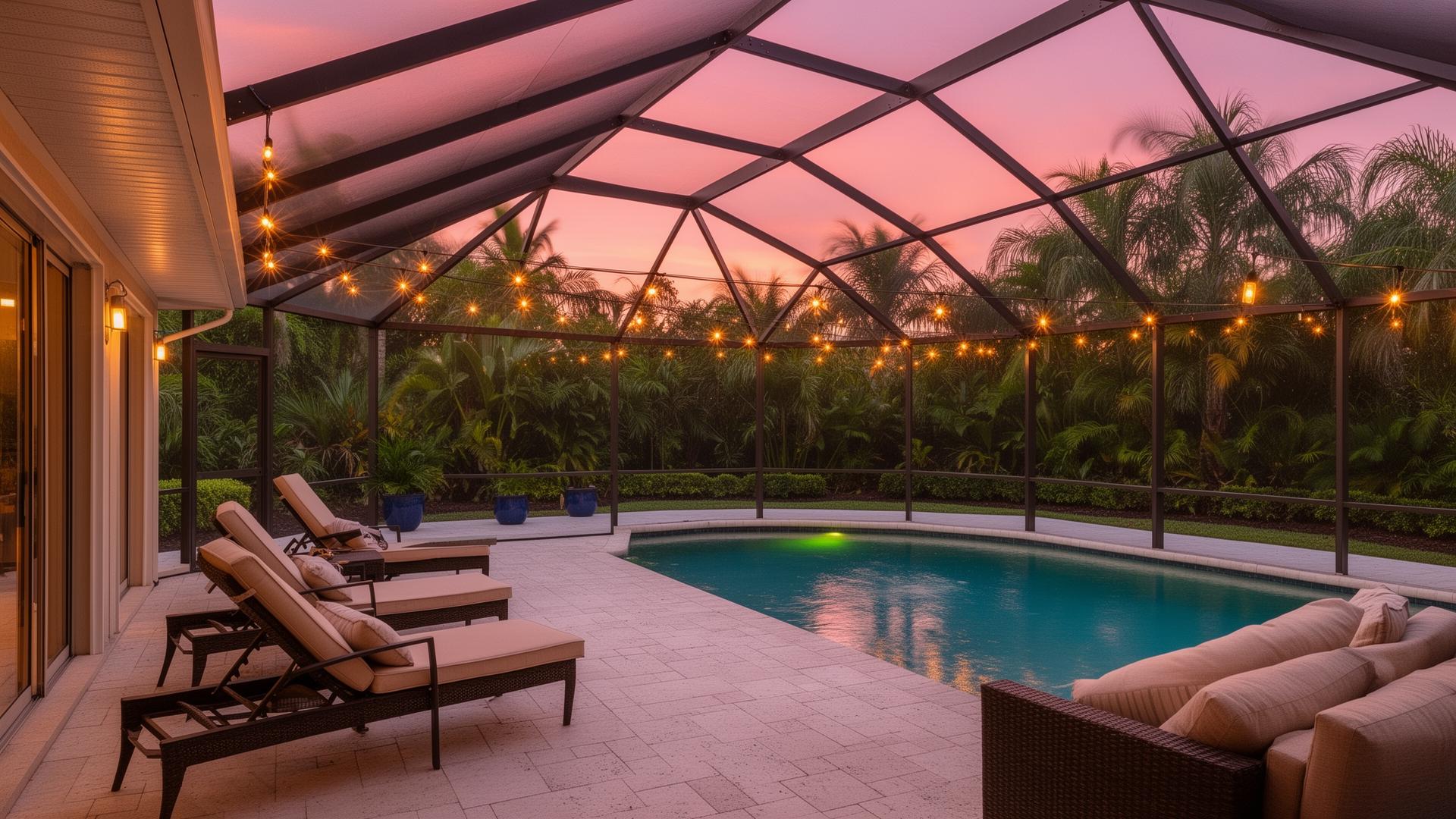
Pool cages in North Port, FL help turn an outdoor pool deck into a more usable screened living area. They reduce entry by many insects and intercept some leaves and larger windblown debris while retaining an outdoor view. That explains their appeal across Southwest Florida, but a screen enclosure is not an indoor room, a hurricane shelter or a guarantee of child safety.
This guide looks at a roughly 90-mile geographic radius around North Port, FL as an educational frame of reference—not an exact driving-distance boundary or a promise of service at every address. Coastal, canal-side, wooded and inland homes can need different screen choices even within the same neighborhood. Start with the problem you want to solve, then compare the mesh, frame condition, door operation, drainage and site-specific requirements.
For a local project, review our North Port, FL pool cage services or the pool enclosure installation page. This article explains the reasons behind an enclosure; those pages cover the services available for your next step.
Pool Cage planning across the North Port, FL region
Pool cage decisions are better organized by property conditions than by a long list of city names. Within the broader North Port, FL-centered region, the following areas provide useful local starting points. Actual travel distance depends on the property, bridges and route; confirm availability and the permitting jurisdiction using the project address.
- Sarasota County: North Port, FL, Venice, FL and Sarasota, FL homeowners can compare pool cage options for inland neighborhoods, mature landscaping and coastal settings.
- Charlotte County: Port Charlotte, FL and Punta Gorda, FL provide local service information for homes where canal views, vegetation and enclosure condition may shape the scope.
- The coastal corridor: Englewood, FL homeowners should distinguish small-insect exclusion from ordinary mosquito screening and consider how a denser mesh changes the view.
- Farther north and south: Lakewood Ranch, FL, Cape Coral, FL, Fort Myers, FL and Naples, FL offer additional regional context. These links do not mean every property has the same wind design, permit process or screen requirement.
A geographic radius is not an engineering zone. Do not copy an enclosure design from a nearby city or assume a neighbor’s permit applies to your lot. Exposure, dimensions, attachments and the current locally applicable requirements must be evaluated for the actual site.
Pool Cages reduce insect entry, but mesh and gaps both matter
Pool cages create a physical separation between the deck and many flying insects. The UF/IFAS Bloodsucking Insects guide explains Florida’s biting-insect concerns. Screening can make outdoor time more comfortable, but it does not eliminate every insect or replace sensible pest management.
Small biting midges—often called no-see-ums—need a different discussion from ordinary mosquito screening. A finer mesh can help exclude smaller insects, but the finished result also depends on intact panels, correctly fitted spline, door sweeps and gaps at the frame. An open door can bypass an otherwise well-chosen screen. Compare the no-see-um screen guide with the pool cage screen material comparison before choosing a product.
Observe when and where insects enter. If the problem is concentrated at a door, repair the closure and gaps before assuming the entire cage needs replacement. If tiny insects are a persistent problem through intact ordinary mesh, discuss a finer screen and its effect on airflow and visibility.
Pool Cage shade is a product choice, not a guaranteed UV rating
Screen material changes how much light reaches the deck and how clearly you see through an opening. Standard insect mesh and dedicated solar-screen material are not interchangeable. Do not assume an advertised solar-blocking percentage is a tested ultraviolet-protection rating, a guaranteed temperature reduction or a substitute for sunscreen.
For a sunny wall, compare the SunTex solar-screen guide with ordinary mesh in the screen material library. Ask for the current manufacturer data for the exact material proposed. Orientation, surrounding shade, roof type and time of day influence comfort; a small sample cannot predict the temperature of a finished enclosure.
Pool cage screen roofs also allow rain through. If your goal is a dry sitting area rather than insect control, compare the insulated roof, pan roof and screen roof guide instead of expecting mesh to behave like a solid roof.
Pool Cages intercept debris without replacing pool maintenance
Pool cage screening can catch some leaves and larger debris before they reach the water. Smaller particles, dust and rain can still enter, and material collecting on a roof panel can add cleaning work. The benefit depends on nearby trees, screen openings, wind and the condition of the enclosure—not a fixed weekly time saving.
Continue testing and balancing the water, cleaning baskets and maintaining the filtration system. Pool chemistry depends on more than screening, so do not reduce sanitizer or testing solely because a cage is present. Around the yard, empty containers that collect water and keep drainage functioning. The UF/IFAS guide to enhancing a professional pest management program supports managing standing water as part of broader pest prevention.
Watch for gutter overflow, wet areas near the house connection and leaves trapped where you cannot safely reach them. Our gutter overflow diagnosis guide helps separate a blockage from a drainage-layout issue.
Pool Cage safety: a screened enclosure is not automatically a compliant barrier
Florida does not require every pool to have a screen cage. For residential pools covered by the law, Florida Statutes §515.27: Residential swimming pool safety feature options lists alternative safety features. When a barrier is used, Florida Statutes §515.29: Residential swimming pool barrier requirements supplies specific barrier requirements.
Whether a particular enclosure participates in a compliant safety arrangement depends on its design, openings, access points and the applicable approvals. A screen wall and a door latch alone do not establish compliance. Ask the local building department how the requirements apply to your property and keep any required safety features functioning.
Never rely on screening in place of active supervision. Do not prop open a safety door, and have sticking doors, failed closers or loose latches evaluated. The pool cage screen door repair guide explains common door problems without treating a repair as a compliance certificate.
Pool Cage views, privacy and pets call for different materials
Pool cages on a canal or landscaped lot are often designed around the outward view. A clearer-view mesh may suit that goal, while a denser insect screen or solar mesh changes the visual effect. Privacy also changes with lighting: do not assume a material that feels private during the day prevents visibility into a lit enclosure at night.
Pet contact is another separate issue. Discuss lower panels and doors where scratching or pushing occurs, rather than selecting one material purely from a durability label. PetScreen pet-resistant screening is a material option, not a guarantee that an enclosure contains every animal or functions as a security barrier.
Screening is not wildlife-proof. Do not approach or try to restrain a wild animal using a pool cage. Keep the focus on ordinary insect and debris control, sound doors and responsible use of the space.
Pool Cage wind design and permits are specific to the property
Pool cage frames, anchors, roof connections and house attachments work together. A stronger mesh does not automatically strengthen that entire system, and a wind-speed label without design context does not establish suitability for your address.
The Florida Building Commission wind-load reference material discusses wind design and references screen-enclosure provisions. This is technical background, not a substitute for the currently adopted code, project engineering or a local permit decision. Review the pool cage wind rating guide and screen enclosure engineering plan guide to understand the questions to ask.
Pool cage work in North Port, FL may involve a city jurisdiction; other addresses may be handled by a county or another municipality. Confirm who issues the permit before ordering work. Panel rescreening, structural repair and a new enclosure are different scopes—do not assume all three have the same approval process. Start with our Southwest Florida pool cage permit guide and verify the actual requirements with the authority responsible for your address.
Pool Cages are not safe shelter during lightning or hurricanes
A screened enclosure remains an outdoor space. The National Weather Service Lightning Tips advises moving to a substantial building or enclosed metal-topped vehicle when thunder is heard and waiting at least 30 minutes after the last thunder before resuming outdoor activity. Leave the pool and enclosure; a metal frame or solid patio roof does not make the cage a safe lightning shelter.
Before tropical weather, follow official local guidance and secure loose outdoor objects when it is safe to do so. The National Weather Service guidance to mitigate wind damage before a storm includes pool supplies among items that can become windborne debris. Do not climb the cage, remove structural parts or cut screens on your own as a storm strategy.
After a storm, stay out of areas with leaning framing, loose members, damaged attachments or electrical hazards. The pool cage post-storm inspection checklist helps organize ground-level observations for a professional assessment.
Pool Cage maintenance starts with safe ground-level checks
Look for tears, sagging panels, screen pulling out of its groove, door gaps, corroded fasteners and staining at drainage connections. Take photographs from the ground and record whether a problem is spreading or follows a storm. Do not walk on enclosure framing or place a ladder against unsupported screen members.
Use the screen manufacturer’s cleaning instructions. Aggressive washing, unsuitable chemicals and physical scrubbing can damage mesh or finishes; stronger cleaning is not automatically better. Trim vegetation so it does not rub the panels, keep accessible drainage paths clear and arrange professional access for roof-level work.
The pool cage maintenance plan and screen spline definition explain how routine care and panel retention relate. Loose anchors, visibly distorted members or a separating house connection call for more than another screen patch.
Pool Cage repair, rescreening or replacement: choose the right scope
- One damaged panel: A localized screen repair may be appropriate if the frame and surrounding mesh remain sound. Check whether a door or rubbing branch caused the damage.
- Widespread worn mesh: Pool cage rescreening addresses the screening system, but the frame, hardware and attachments still need assessment before new mesh is installed.
- Loose or damaged structural connections: Ask about pool cage structural assessment and upgrades rather than assuming a full rescreen fixes the underlying problem.
- A different footprint, roof or view: Compare a new enclosure or redesign, including engineering, drainage and approval requirements. Review lanai screen installation if the intended use is a screened sitting space rather than a full pool enclosure.
Pool cage estimates should identify the actual material, affected openings, repair scope, access needs and exclusions. The pool cage estimate checklist makes proposals easier to compare without guessing at prices or warranties.
Pool Cage questions to prepare before requesting an estimate
Write down your property address, the main problem, whether the existing cage has structural damage, the approximate affected area and your priorities for insect control, view, shade and pets. Photos of the full enclosure, doors, damaged panels and house connection can help explain the request; do not take unsafe measurements or access the roof to obtain them.
For homes around North Port, FL, request a pool cage or lanai screening estimate with the actual address so service availability and project scope can be confirmed. A regional guide is a useful starting point, but only a property-specific assessment can determine the right work for your home.
Authoritative references and further reading
The linked UF/IFAS publications support insect and pest-management explanations; the Florida statutes describe residential pool safety provisions; Florida Building Commission material supplies wind-design background; and National Weather Service guidance explains storm and lightning precautions. Each source is linked where it informs the discussion. These references do not certify a particular enclosure, guarantee screen performance or replace local approval.