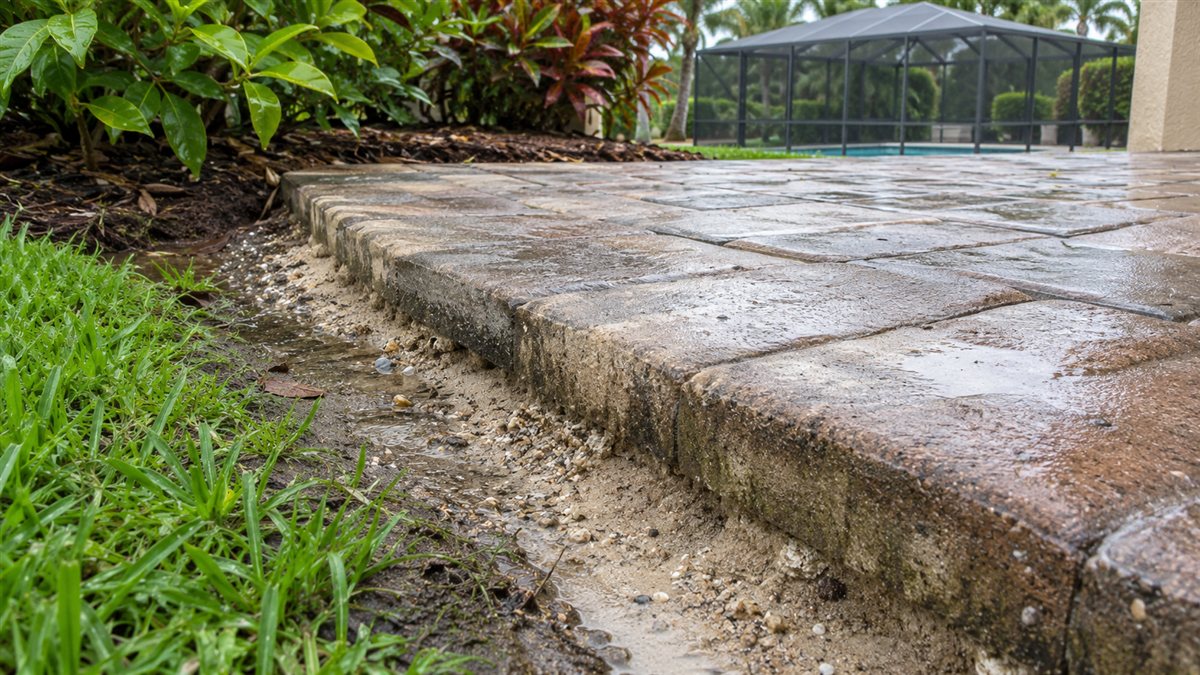
Paver washout is loss or displacement of paving-related material associated with water flow; visible sand loss does not identify the full extent below the surface.
Generated educational illustration — not a documented project or a photograph of the assigned metadata location.
Surface loss versus concealed loss
CMHA recommends maintaining joints and observing pavement performance. Water-related loss can appear in joints or at edges, while underlying conditions may not be visible. Do not assume a small sand trail proves complete base removal or a specific drainage defect. See CMHA operation and maintenance of interlocking concrete pavement.
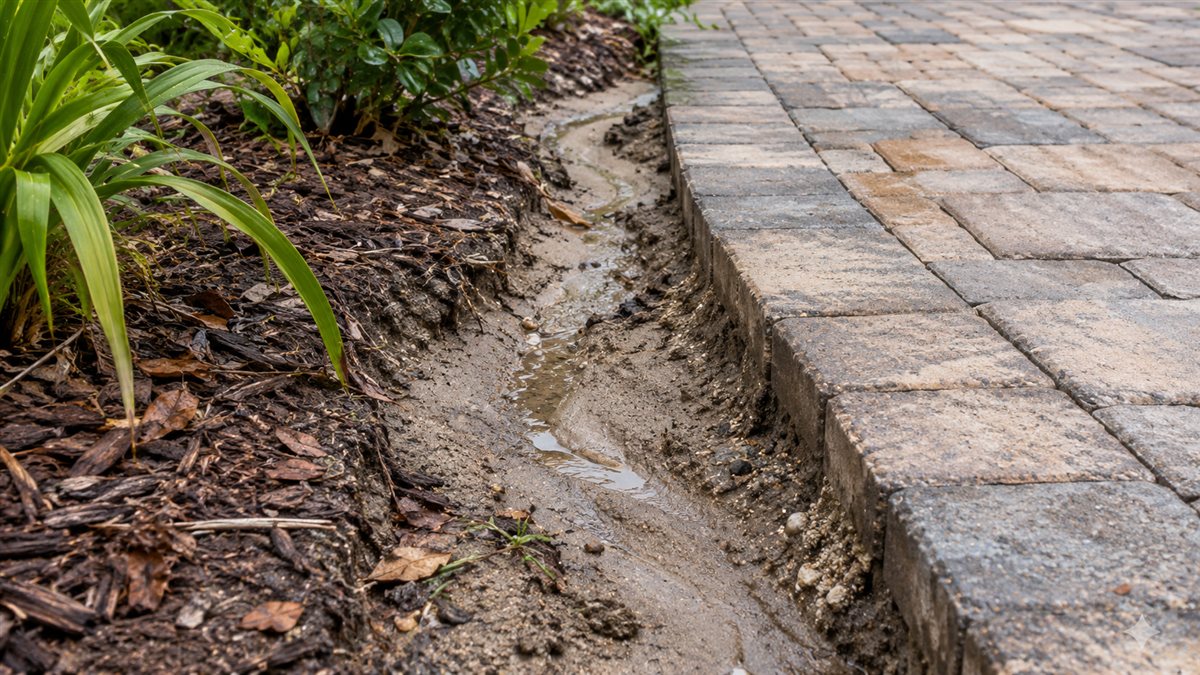
Follow the observed water route
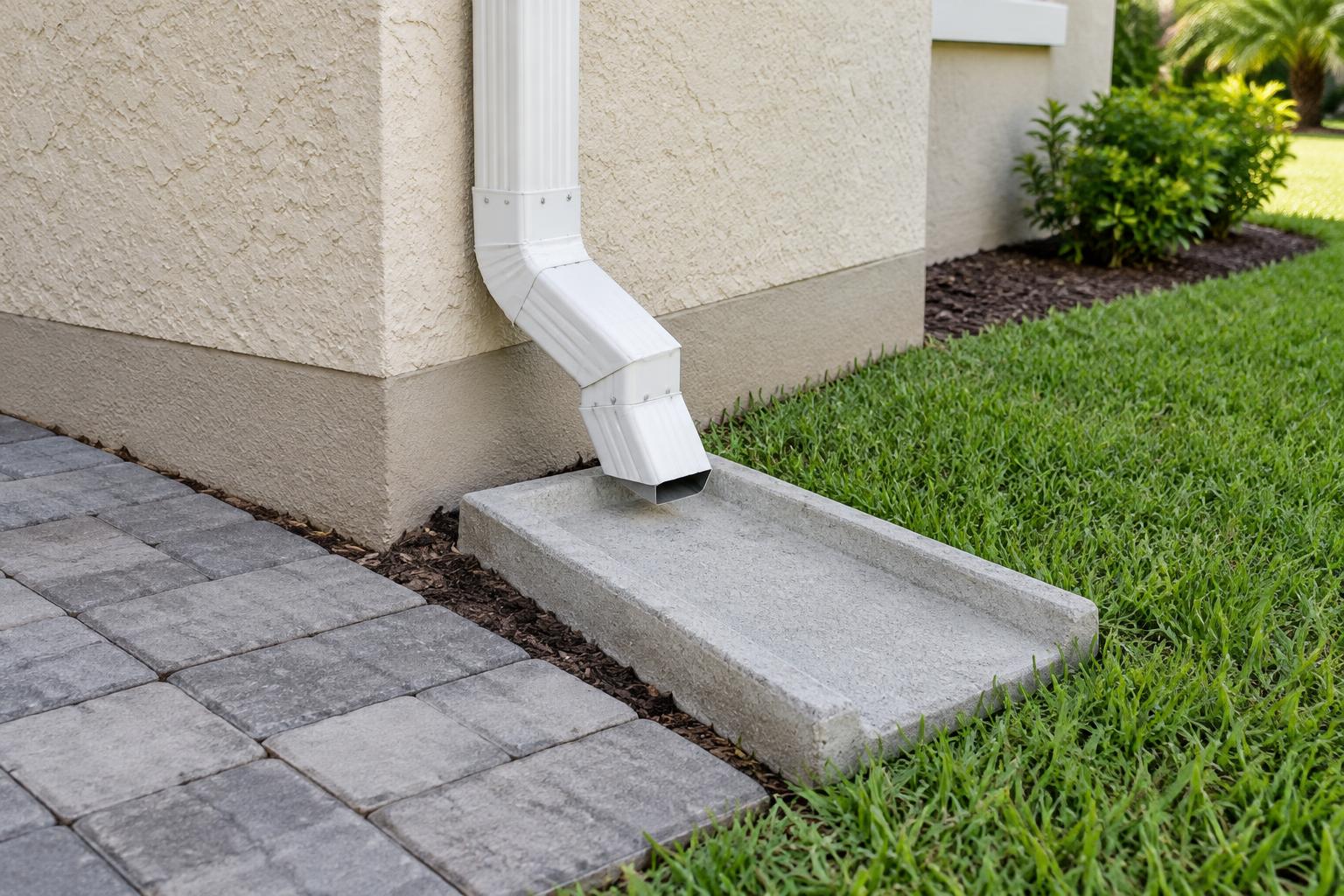
Record where water enters the paved area, crosses joints and leaves the edge. Downspout discharge, concentrated roof runoff and surrounding slopes may be relevant if observed. Photographs during rain from a safe place can support the assessment.
Refill does not reroute runoff
Adding compatible joint material may form part of maintenance, but does not redirect concentrated water or restore lost support. Discuss the water path and edge restraint when loss recurs. Sealer is not a universal cure for erosion beneath paving.
Coordinate paving and drainage decisions
Ask whether the pavement repair and runoff change need to be planned together. Moving discharge without checking its new receiving area may relocate the concern. Avoid assuming the correct solution is always a larger gutter or another buried pipe.
Planning the next step
Identify whether the pavement carries pedestrians, vehicles or poolside traffic and provide photos of the full area, not just one joint. Mention previous repairs, known coatings and where runoff travels. Ask which observations support the proposed treatment and whether supporting layers need assessment. This guide concerns conventional concrete pavers unless a different system is specifically identified; natural stone, mortared and permeable assemblies require their own guidance.
Manufacturer instructions apply to the identified product or system. General guidance does not establish a project-specific structural rating, code approval or repair specification.
Paver Washout: practical planning details
Trace the visible water route across the affected area and photograph any nearby outlet or roof drip line. Ask the repair scope to distinguish missing joint fill from possible loss beneath the units. If the pattern follows repeated concentrated flow, discuss that route separately from material replacement. A clear investigation plan is more useful than assuming the visible sand trail establishes the full depth of damage.
A question to bring to your estimate
Will the water source be reviewed before the washed-out area is rebuilt?
These references provide background for the topic. Product instructions apply to the identified product; research and general guidance do not establish the capacity, permit status or legal outcome of an individual project.
Paver Washout: detailed decisions, inspection and care
Distinguish where the material was lost
A trail of sand at the surface may come from joints, an exposed bedding edge or another nearby source. Record where the trail begins and where it ends. Show any voids, unsupported-looking edges, changed elevations and neighboring outlets. Keep the observations separate from estimates of hidden loss until the affected construction is examined.
For a recurring problem, compare photographs from more than one rain event where observation can be made safely. Note whether the water follows the same narrow route or spreads across a larger area. A short video from a sheltered location can help show the direction of flow without requiring anyone to stand in storm runoff.
Review roof discharge and the receiving area together
EPA’s downspout redirection guidance explains that redirecting roof water requires consideration of the receiving location and local restrictions. Moving discharge away from one paver edge should not create a new problem at a foundation, walkway or neighboring property.
Ask who is responsible for the paving work and who is responsible for the water-management change. Put the sequence in writing. If only the damaged paving is included, record that limit rather than assuming a separate runoff source has been corrected.
Look at transitions where material can escape
CMHA’s edge-restraint guidance addresses details that retain bedding near boundaries and drainage structures. The appropriate detail depends on the assembly. A visible bead of sealant or an improvised patch should not be treated as evidence that the intended retention and drainage functions are both satisfied.
Ask the contractor to identify the actual escape route before selecting a treatment. At a drain, curb or exposed border, request a sketch showing how water will leave while the intended pavement materials remain supported. Avoid substituting a sealed boundary for a designed drainage path without review.
Define the repair and follow-up
Mark the initial investigation area and the conditions that would expand it.
Record which material layers are replaced and which are retained.
Document the revised runoff route if one is part of the work.
Review transitions and access to drains after reinstatement.
Keep photos for comparison if sediment trails or low areas return.