Seamless gutter downspout discharge is the location and manner in which collected roof water leaves the pipe and enters its receiving area.
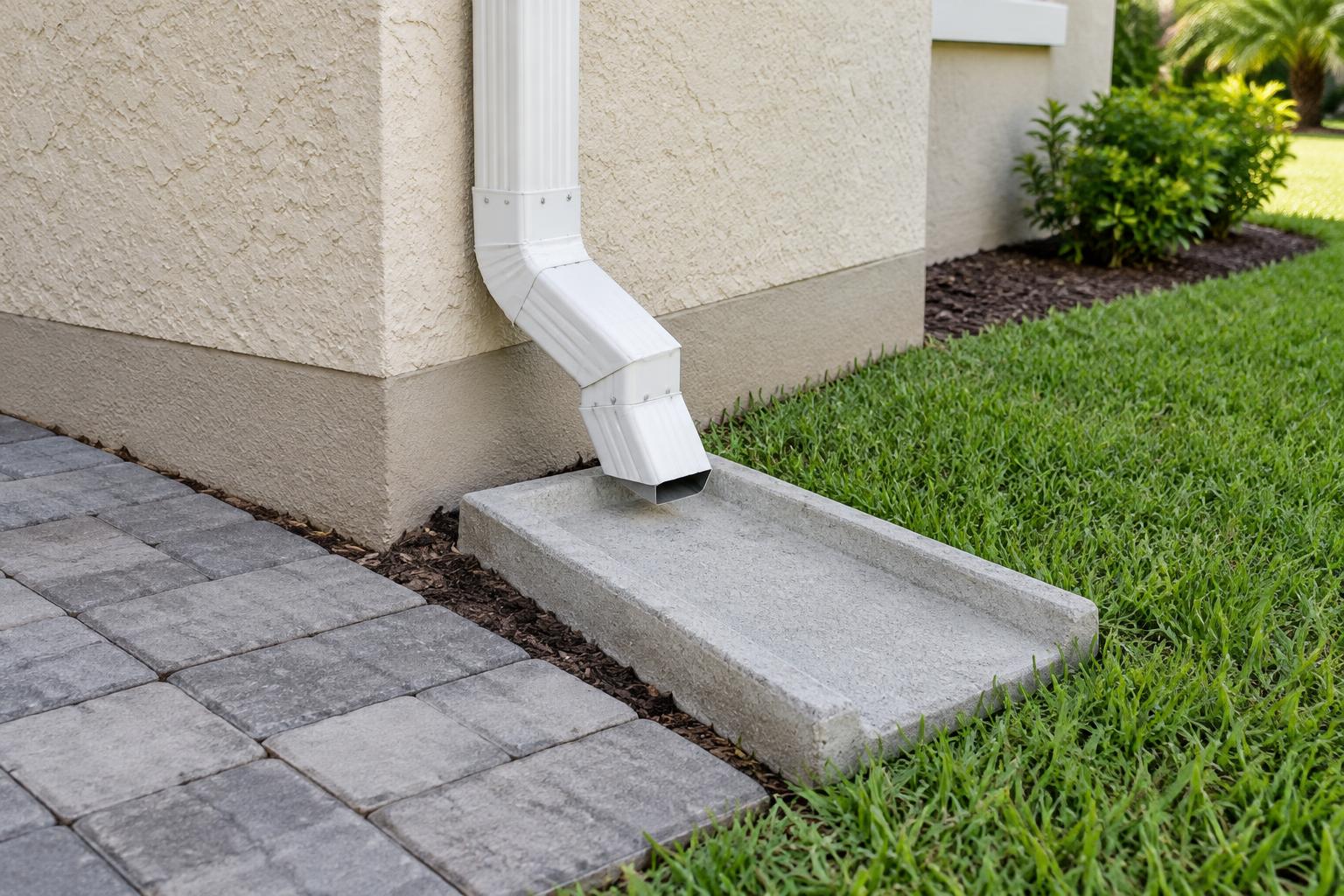
The last part of roof-water management
UF/IFAS Florida-Friendly Landscaping guidance discusses managing runoff with appropriate planted or pervious areas. A working gutter is incomplete if its discharge sends water to an unsuitable place. This is landscape guidance, not approval of a specific outlet design. See UF/IFAS Florida-Friendly Landscaping runoff guidance.
Surface and connected destinations
Roof water may discharge at the surface or into a designed drainage arrangement. Identify the actual endpoint before changing piping. A buried pipe’s destination cannot be assumed from the visible downspout connection alone.
Property and access boundaries
Consider walls, walking routes, enclosure supports, paver edges and adjoining property when reviewing the endpoint. Do not create a nuisance by moving runoff elsewhere. Local drainage requirements and site constraints control what arrangements are appropriate.
Observe performance in real rainfall
From a safe position, note flow, pooling, erosion and whether water returns toward the home. A dry-weather view may miss concentrated runoff. Report the observed pattern and any changes rather than claiming a single discharge detail caused hidden damage.
Safe inspection and project boundaries
Record the condition from the ground and explain whether it appears during rain or after the gutter has drained. Roof access, loose sections and concealed fascia attachments require appropriate professional access and assessment. Never climb or walk on a pool cage to reach a gutter. A drainage component at a house-to-enclosure connection may also need structural review; this definition does not prescribe a connection repair.
Related services and definitions
Explore seamless gutter installation and drainage assessment or discuss the observed condition through our free estimate request form. For local service information, see our North Port, FL service-area page.
Frequently asked questions
Does flowing water prove the discharge location is suitable?
No. The receiving area and downstream path also matter.
Can I assume a buried pipe connects to a storm drain?
No. Its destination needs verification.
May roof water be redirected onto a neighbor’s property?
Do not create harmful discharge; check applicable rules and the site-specific plan.
Source reading
Manufacturer instructions apply to the identified product or system. General guidance does not establish a project-specific structural rating, code approval or repair specification.